By Dr. Michael Williams
Every year, America celebrates Independence Day on July 4th. In the year 2026 we celebrate 250 years since the United States of America declared her independence from Great Britain.
As we see every year to celebrate many businesses are closed, and people spend the day with cookouts, getting together with friends, and watching fireworks once the sun goes down. Unfortunately, as America drifts further away from her Christian-Judeo heritage, the historical meaning of the day, along with the Biblical foundations of the day are becoming lost from the mindset of the general population. With this in mind, what does the Bible say about the Declaration of Independence?
The Bible Predates the Declaration
The first thing that needs to be understood is that the books, which make up the written Bible, were completed about 96 A.D. with the Apostle John’s writing of the Book of Revelation. This very fact means that the written Bible predates the Declaration of Independence by about 1680 years. Common sense would also tell us that if the written Bible was completed nearly 17 centuries before the Declaration of Independence, it would be highly unlikely that the Bible would mention it. An examination of the Bible bears out this fact that there is no mention of the Declaration of Independence. However, there are plenty of references to the verbiage contained in the Declaration of Independence that are spoken about in the Bible.
What Was Happening When the Declaration was Conceived?
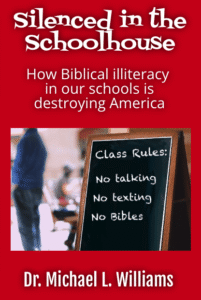
To set the historical reference of the Declaration of Independence, here is a brief excerpt from the book Silenced in the Schoolhouse, written by this author, that describes the events surrounding the declaration.
Only a few short months earlier, on July 2, 1776, the Continental Congress in Philadelphia had declared independence from England after months of extensive debate. The Continental Army had been waiting during the debates in New York for the arrival of the British ships from Boston after previously encountering the British in Boston. It was not going to be a fight like the one they had recently won in Boston. While King George III earlier had lamented over sending troops 3000 miles away to kill fellow countrymen, he was now serious about putting an end to what he considered to be an insurrection caused by a few “whose corruptions are notorious”.[i]
Monday, July 1, 1776, the day before the declaration of independence from England was to be made, John Adams was preparing for the final debates to be held in the Continental Congress. He knew that when the British arrived in New York there would be great bloodshed. Yet, he understood that without the shedding of blood, there could be no freedom from tyranny. He wrote a letter to a former delegate Archibald Bulloch, who had recently become the president of Georgia, updating him on the events that had transpired and the costs to be considered:
“The object is great which we have in view, and we must expect a great expense of blood to obtain it. But we should always remember that a free constitution of civil government cannot be purchased at too dear a rate, as there is nothing on this side of Jerusalem of equal importance to mankind.”[ii]
The arguments, meetings, and debates over the weeks and months had been exhausting; yet Adams knew it was time for a decision.
After John Hancock sounded the gavel to start the proceedings, the motion was read to declare independence. John Dickinson stood to give an eloquent, but firm speech against the motion, comparing it to someone who would make the decision to “brave the storm in a skiff made of paper.”[iii] Dickinson believed that every attempt to reconcile with England should be made and that the motion to declare independence was premature. Despite his position being unpopular, he firmly argued his position as a matter of principle. When he had finished, he sat down and the room became silent except for the rain that had begun to strike the windows.
After a short while, Adams then stood to speak. The rain had become much more intense and a storm had begun to rage outside. Despite the intensity of the storm, which at other times would unnerve him, he was sensitive to the historic significance of that day. He was not a particularly graceful or eloquent speaker, yet his words would prove to be so powerful and thought provoking that the body of delegates would soon be moved from their seats.[iv] He found himself “carried out in spirit” not unlike that of some enthusiastic preachers he had heard. The debate continued that day for nine hours with a preliminary vote for a passage of the motion failing and the proceedings adjourned until the following day.
That night, while they met for food and drink in the numerous inns and taverns throughout the city, spirited discussions concerning the day’s business continued until the wee hours of the morning. Just when one would think there was enough to talk about already, word was received that the British ships from Boston had begun to arrive at New York. The word would spread through the city like wildfire and all concerned anticipated what effect this latest news would have on the next day’s proceedings.
On July 2, 1776, when Congress resumed session, inexplicably some of the delegates that had previously voted against the motion did not show up. When the preliminary arguments were completed by mid-morning, a vote was taken and the motion passed! Independence was declared! John Adams would later write to Abigail, his wife:
“The second day of July 1776 will be the most memorable epocha in the history of America. I am apt to believe that it will be celebrated by succeeding generations as the great anniversary festival. It ought to be commemorated as the Day of Deliverance by solemn acts of devotion to God Almighty. It ought to be solemnized by pomp and parade, with shows, games, sports, guns, bells, bonfires, and illuminations from one end of this continent to the other from this time forward forever more.”[v]
Later, when the Declaration was finalized and signed, Benjamin Franklin was quoted as making a sobering statement concerning the event: “We must all hang together, or most assuredly we shall hang separately.”[vi] With these words, the seriousness of what they had just done was made clear to all; that King George III would see this as an act of treason requiring their hanging. Later, they would discover that the King did have a list of names that would meet that very fate if captured.
This attitude was nothing new. A little over a year earlier, when the British Redcoats were marching on Lexington, Massachusetts, Paul Revere arrived at the house of Reverend Jonas Clark. Reverend Clark was accompanied by none other than John Adams and John Hancock. The next morning when confronted by a Redcoat Major, Reverend Clark responded to the Major’s request to lay down their arms in the name of the King by saying, “We recognize no sovereign but God and no King but Jesus.”[vii] This statement would prove to be a rallying cry throughout the revolution.
They Followed God’s Providence and Authority
These events were not the actions of group of mere deists wanting to be rebellious against authority and their king. They were acts of men and women who carefully weighed what the were doing in light of God’s providence and authority over the affairs of the nation. The very steps they took that brought them to this day were carefully considered in light of the teachings of Scripture and they were adamant about making sure that how they proceeded was steeped in humility and reverence. Simply stated, they recognized that they were not perfect and they believed that everything they did was being watched by God.
While much more can be told about the historical events and the mindset that went into the formal Declaration of Independence, a simple examination of the Declaration of Independence in light of Biblical references tells much more.

Was it an Act of Rebellion?
While there are many more Bible verses that apply along with historical accounts in Scripture, it is clear that the grievances that the colonists were presenting to the King were in keeping with what God said should be expected of a protectorate. Likewise, what many people today do not realize is that the colonists were very aware that declaring independence was not Biblically allowable; at least not until the British Parliament passed the Prohibitory Act on December 22, 1775. The following excerpt from Chapter Three of Silenced in the Schoolhouse explains as follows:
Before then, there had been a series of acts passed by Parliament applying to the colonies that restricted trade; navigation; allowed for illegal searches; restricted the uses of currency; applied duties on documents through stamps; required colonists to house troops; added duties on goods; and restricted the importing of tea except through the British East India Tea Company.

These acts would have all been considered unconstitutional against British subjects anywhere else in the world. This was the main premise for why the colonists objected to these acts. When their grievances were not redressed, as required by law, the colonists resisted these acts as being unlawful, first through their elected representatives and later, by boycotts and force.

When the Prohibitory Act was passed it literally forced the hand of the colonists. The Act literally declared “America to be an independent hostile state."[viii] This act was passed by Parliament in response to a speech that had been given on October 26, 1775 by King George III urging Parliament to legally remove the colonists from his protection and treat them as foreign enemies. The act declared war against the thirteen colonies, forbade all trade with them, and set up a naval blockade. John Adams wrote a letter to General Horatio Gates concerning the act:

“It throws thirteen Colonies out of the royal protection, levels all distinctions, and makes us independent in spite of our supplications and entreaties…It may be fortunate that the Act of Independence should come from the British Parliament rather than the American Congress; but it is very odd that Americans should hesitate at accepting such a gift from them.”[ix]

Edmund Quincy, another founder, would point out: “it is a maxim of common law according to William Blackstone that upon the duties of Kings; that, when protection ceaseth, allegiance ceaseth to be the duty of the subject.” This meant that legally, the colonists were no longer subjects of the King because the King no longer protected them.[x] Blackstone was a well known jurist and professor of law who wrote Commentaries on the Laws of England from 1765-1769.[xi] His commentaries on law are still highly regarded today.

Little, if anything, is written in most modern textbooks about the details of the Prohibitory Act, but Biblically speaking, it was very important. Numerous times in Scripture, God removed His blessings from the Israelites for their rebellion throughout the entire Old Testament (Numbers 20:24, Numbers 27:12-14; Deuteronomy 1:26-37, Deuteronomy 9:7-8, Joshua 22:22; 1 Kings 12:19, etc.) Fearing the same, the founding fathers knew that submission to the King and His ordained government was commanded by God; not to do so would be the sin of rebellion. The Bible addresses rebellion in several places:

(1 Samuel 15:23) For rebellion is as the sin of witchcraft, and stubbornness is as iniquity and idolatry. Because thou hast rejected the word of the LORD, he hath also rejected thee from being king.

(Psalm 66:7) He ruleth by his power for ever; his eyes behold the nations: let not the rebellious exalt themselves. Selah.

(Proverbs 17:11) An evil man seeketh only rebellion: therefore a cruel messenger shall be sent against him.

Once the Prohibitory Act passed, the King no longer had authority over the colonists. Biblically speaking then, declaring independence would not be an act of rebellion. However, since the people were no longer under the authority of the King, a new authority had to be created. By declaring independence, a new authority was created, and the rest of the world was served notice that a new nation had been born. Technically speaking then, America was independent on December 22, 1775, but was not born as a new nation until the first signatures were placed on the final draft of the Declaration of Independence on July 4, 1776.

There was a second reason for declaring independence. According to Thomas Jefferson’s autobiography, there was a concern amongst those debating independence that if the thirteen colonies were not to unanimously declare independence and identify themselves as a new nation, France and Spain might try to reclaim by force the colonies they had lost to England. Likewise, without a declaration, there was the concern that the English might give the same colonies to France and Spain in consideration for their help in the matter.[xii]
Final Thoughts
In consideration of what we have just learned, it can be clearly seen that the foundations of faith that the founding fathers had put in place played a key role in the events of their time. Likewise, it can be clearly seen that the foundations of faith that America has abandoned is playing a key role in her demise. As we drift further away from God, there is only one solution as found in Scripture:
(2 Chronicles 7:14 KJV) “If my people, which are called by my name, shall humble themselves, and pray, and seek my face, and turn from their wicked ways; then will I hear from heaven, and will forgive their sin, and will heal their land.”
In conclusion, what does the Bible say about the Declaration of Independence? Quite a bit! However not too many people know it anymore.
Click on the image below to get Dr. Mike’s book “Silenced in the Schoolhouse”
________________________________________
All references as listed in Silenced in the Schoolhouse bibliography. Numbers changed for web publication.
[i] McCullough, David. 1776, 15.
[ii] McCullough, David. John Adams. 125-126.
[iii] McCullough, David. John Adams. 126.
[iv] McCullough, David. John Adams. 127.
[v] McCullough, David. John Adams. 129-130.
[vi] Bartlett, John.https://www.bartleby.com/100/245.21.html
[vii] Jennings, Charles A. https://www.truthinhistory.org/NoKing.htm
[viii] Fisher, Gene & Chambers, Glen, p. 42
[ix] Newman, Joseph, et al., p. 69
[x] Fisher, Gene & Chambers, Glen, p. 73.
[xi] Wikipedia,https://en.wikipedia.org/wiki/William_Blackstone
[xii] Jefferson, Thomas, Autobiography by Thomas Jefferson 1743-1790,

Dr. Michael L. Williams, Head of Ministry Operations and Technology at Christianity Every Day, is a Christ-centered Author, Educator, Biblical Counselor and Advisor. He is ordained in Pastoral Ministry and formerly the founding Pastor of Selah Mountain Ministries, a church started along with his wife, Pamela Rose, after several years of pastoral experience and training in Biblical Counseling. Selah Mountain provided Biblical counseling and education to the public on how to overcome life issues Biblically on topics such as anger management, marriage, addictions, and other subjects – often referred to as mental illnesses.